




PREMSTAETTEN, Austria, and MUNICH, Germany – ams OSRAM has published its 2025 Annual Report. The report includes a Sustainability Report, prepared on a voluntary basis, applying selected European Sustainability Reporting Standards (ESRS).
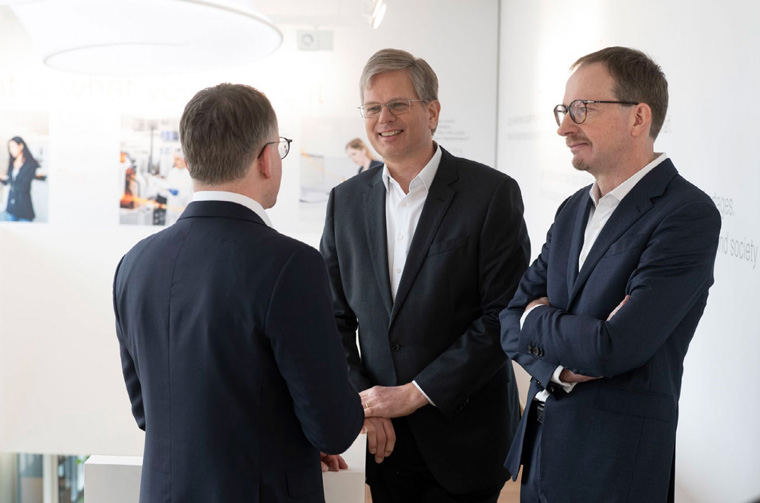
The beginning of the report includes an interview with Aldo Kamper (CEO), Rainer Irle (CFO), and Dr. Margarete Haase (Chairperson of the Supervisory Board):
Dear Aldo Kamper, a year ago you said that for all the global uncertainty, we could look to the year with confidence. Looking back on 2025, what are your thoughts now? How did ams OSRAM hold up?
Kamper: We made substantial progress. Overall, 2025 was a year of focused and disciplined execution. And this despite some significant disruptions originating from the political sphere, including a fundamentally changed global tariff regime. But we have pushed ahead with the realignment of the business and took a number of decisive portfolio actions. At the same time, our traditional automotive lighting business delivered a gratifying performance, thanks to our “Last Man Standing” strategy in a structurally declining market. Through a broad set of measures, we have laid a solid foundation for the next phase of growth as a digital photonics powerhouse. An unparalleled expertise in light-based emitter and sensor products is combined in our Company. Our design wins show that our technologies are sought after on the market. We have, in total, achieved a lifetime volume of more than EUR 5 billion. This is the revenue of the future. Our customers trust us and our products.
You mentioned digital photonics – how do you define it, and where do you see the potential?
Kamper: Photonics as such comprises technologies for the generation, control, or detection of light. Traditionally, this has largely involved analog photonic components and systems. The term ‘digital’ refers to the increasing pixelation of the emitters and sensors and the integration of digital control, notably through ASICs, which are now embedded in many of our advanced emitters and sensors.
The resulting potential lies in our unique technology mix and what is the broadest photonics portfolio on the market. It combines industry-leading LEDs, lasers, and micro-emitter arrays together with a comprehensive range of sensors, complemented by proprietary driver and IC technologies.
This enables a broad spectrum of intelligent applications – ranging from dynamic lighting solutions in automotive headlights and projection displays in augmented reality glasses, to sensors for smart robots and data transmission via light in AI data centers.
Digital photonics offers numerous attractive growth opportunities on both the emitter and the sensor side. For instance, micro-emitter arrays open up three key markets for emitters: in the EVIYOS advanced adaptive car headlights, which we already deliver in large quantities. In energy-efficient, highly compact projectors for augmented reality displays for next-generation smart glasses. And in optical data transmission in AI data centers where they have the potential to enable higher data rates with superior energy efficiency.
We are also well-positioned on the sensor side. Spectral sensors are already a business area worth a few hundred million euros, and we expect further growth, thanks to new product generations and the emergence of foldable devices with two displays. Biosensor technology is also continuing its growth as wearables are becoming more and more widespread and allow the optical measurement of a growing number of vital parameters. Finally, our multi-zone direct-time-of-flight sensors are being increasingly used in devices and robotics applications to allow high-precision 3D measurements.
These are just a few examples of digital photonics.
You also made a reference to portfolio decisions earlier. How do current decisions differ from those you announced in summer 2023 as part of the ‘Reestablish the Base’ strategic efficiency program presented at the time?
Kamper: Here you can clearly distinguish between different phases. The portfolio measures initiated under our strategic efficiency program ‘Re-establish the Base’ were aimed at restoring the profitability of our business. A number of product lines were structurally loss‑making. We therefore either divested them, restructured them, or phased them out. However, against the backdrop of continued weakness in several of our core markets and a high level of indebtedness, a second phase became necessary. We also prepared profitable businesses for divestment, with the objective of achieving attractive valuations and thereby accelerating deleveraging. We announced this step at the end of April 2025, and since then two transactions were successfully agreed. The specialty lamps business has been transferred to our Japanese competitor Ushio. And with Infineon we signed an agreement on the sale of our non-optical sensor business in early 2026. What is important here is that both divestments support us in our strategic realignment, they are financially attractive, and were concluded with established, highly reliable partners.
To what extent will the sales be reflected in the balance sheet?
Rainer Irle: When we announced the plans, we made it clear that our objective was to reduce our debt load to a healthy level. An annual interest burden of up to EUR 300 million is simply too high relative to our earnings power. We can use this money far better to develop our business. The total proceeds from the divestments, amounting to just over EUR 670 million will allow us to repay a substantial portion of our debt. On a pro forma basis, this will reduce the ratio of net debt to operating earnings, i.e. EBITDA to around 2.5. At the same time, it is important to note that we have divested only slightly more than one‑tenth of our revenue base. At the end of 2025 we began the buyback of bonds maturing in 2027. As a next step, we will look at buying back the high-yield bonds maturing in 2029. With a significantly improved risk profile, we expect to benefit from markedly more favorable financing conditions in the capital markets. Taken together, these measures should translate into a substantially lower interest burden. We expect it to be cut in half.
You also received additional liquidity to repay debts by restructuring the provisions for pensions. What is the background?
Irle: Historically, we had set aside a lot of money for the pension benefits of current and former employees in Germany. Against the backdrop of our high debt level, we carefully reviewed whether the extent of these earmarked funds was still appropriate, particularly given that we are a member of the Pensions‑Sicherungs‑Verein, the mutual insurance scheme safeguarding occupational pensions in Germany. Our analysis showed that certain pension claims were, in effect, secured more than once. At the same time, significant amounts of capital were tied up in low-yield assets, while we pay a high level of interest to finance the Company. The switch to a new trustee and structural adjustments in pension finance enabled us to release several hundreds of millions of euros in liquidity and deploy these funds directly toward debt reduction. Importantly, this was achieved while at the same time improving the level of security for the pension beneficiaries, as the inflation adjustment of their pension entitlements has now also been secured.
You also resolved to find a solution for the second factory in Kulim, which is currently not required. Have you made any headway?
Irle: We continue working hard to find a buyer. The factory is a valuable asset for which we can expect a reasonable amount. This will, however, also depend on an improvement in the semiconductor cycle, particularly in those segments that require a manufacturing facility of this scale and specification. I am certain that in that case we will reach a good agreement with one of the interested parties. Until then we will need a little patience.
Your financial conclusion for 2025 as a whole?
Irle: Our progress is quite impressive. In the semiconductor core portfolio, we recorded substantial currency-adjusted growth. Additionally, we were able to further improve the Group’s profitability. The ‘Re-establish the Base’ program, which we implemented a full year ahead of schedule, certainly contributed to this. We have secured our liquidity position also with a view to a possible decision on the purchase of the remaining outstanding shares in OSRAM Licht AG. In terms of free cash flow, we substantially exceeded our target of at least EUR 100 million. An important contribution came from funding granted by the Austrian government under the European Chips Act for our site in Premstaetten. In December, we resolved the remaining open questions and received an initial, substantial payment. This, too, manifests the confidence and expectations in us as a major player in the European and global semiconductor industry.
Do the results for the past year meet the expectations the Supervisory Board had of the management team?
Margarete Haase: The Supervisory Board defined 2025 as a crucial phase of stabilization and streamlining. Against this backdrop, the continued sharpening of the focus on the core business was both correct and necessary. The strategic considerations of the Management Board were discussed in depth within the Supervisory Board, with the various options carefully assessed. Throughout the divestment processes, the Supervisory Board was kept fully and continuously informed. It was particularly important to us that the measures taken would leave the Company in a structurally stronger and sustainably profitable position in the long term. This has been achieved through the decision to sell the non-optical sensors and through the clear strategic focus on digital photonics. The Supervisory Board is convinced that this represents the best solution financially and with regard to the Company, its employees, and its location. We congratulate the Management Board on the successful implementation.
At the same time, we are fully aware that further steps will need to be taken in the 2026 financial year. The announced divestments must now be implemented, the organizational structures adjusted accordingly, and the Company’s competitive position substantially strengthened. In addition, the existing portfolio will need to be further developed. In this phase as well, the Supervisory Board will provide close support to the Management Board, drawing on its broad range of expertise. We also recognize that the Company has not yet reached the level of performance that shareholders ultimately expect — but the direction taken is clearly the right one.
Keyword competitiveness – how specifically do you aim to improve it?
Kamper: There is no doubt that further efforts are required. Our industry is undergoing rapid change. Competition from China is intensifying, and established players, for instance from Japan, never sleep. We are countering this pressure through a combination of targeted efficiency improvements and cost‑optimized product designs, particularly in segments with a high level of price competition. We are also defending our intellectual property very successfully, particularly in the area of horticultural lighting. To further differentiate our technological expertise from that of new competitors, we have now signed the third cross-license agreement with our competitor Nichia. In addition, we continue to systematically develop the OSRAM brand, working with existing and new partners. This includes selectively licensing the brand for product families that are fully aligned with its positioning and the brand promise, but which we do not manufacture ourselves.
Irle: At the same time, we are of course also strengthening our financial basis, the prerequisite for the success of our business. Since 2023, we have achieved a great deal through the ‘Re-establish the Base’ program. In parallel, we are also pushing ahead with the use of artificial intelligence across the Company in order to unlock further efficiency potential. But the overall strain on the business has increased. In 2025, for instance, we experienced historically high price surges for raw materials such as precious metals. In an increasingly volatile global environment, we must expect such shocks to occur again. Accordingly, it is essential that the Company becomes more resilient in both its cost and its earnings structure. For this reason, we have launched a new transformation and savings program, called “Simplify”, covering the years 2026 to 2028. The program is designed to permanently reduce structural costs by a total of EUR 200 million. It also includes personnel-related measures. By the end of 2028, we plan to reduce the workforce by around 2,000 positions, approximately half of them in Europe and the other half in Asia.
Kamper: And let’s not forget, our clear objective is to simplify processes and streamline structures across the organization. The opportunities offered by artificial intelligence, as mentioned by Rainer Irle, play an important role in this transformation. Above all, we must and will become faster in our decision-making.
Haase: The Supervisory Board is fully aware that the cuts planned for 2026 and the years thereafter will be painful. But they are necessary. For this reason, the Supervisory Board will pay close attention to ensuring that the measures are implemented fairly for those affected, while at the same time being carried out with consistency, responsibility, and due care.
In brief, what can shareholders expect from their Company, from ams-OSRAM AG for the year 2026?
Kamper: Like last year, the focus will be on disciplined execution. We are facing a demanding agenda, and 2026 will be a year of transition. Our goal is to emerge from this phase strengthened, as a leading provider of digital photonics, addressing markets with significant long-term potential, as mentioned above. Our technologies are key enablers of major megatrends, including autonomous driving, augmented reality, data centers for artificial intelligence, robotics, and smart health. Our success in these fields is largely in our own hands.
At the same time, we must remain flexible. The political and geopolitical environment, particularly at the global level, remains difficult to predict. Unexpected developments and even major disruptions cannot be ruled out. We are preparing ourselves for this.
Irle: From a financial perspective, 2026 will certainly remain challenging. However, with our accelerated deleveraging, we have established a very solid starting position. At the same time, the divestments inevitably mean that we are not only reducing revenue but also foregoing operating earnings contributions. The “Simplify” program will help us offset this. It includes a higher degree of automation to secure the competitiveness of our European sites over the long term and to selectively strengthen and expand our manufacturing footprint in Asia.
Haase: The Supervisory Board is convinced that the direction taken is the right one as the Company heads towards a successful and sustainably profitable future. It will be essential to maintain and further strengthen the trust of our employees, customers, political stakeholders, and, in particular, our shareholders. ams OSRAM today stands for the greatest possible degree of transparency and consistency. Together with the Executive Management Board, we are committed to continuing on this path.
The FULL 2025 Annual Report is now available here.
Tagged with ams OSRAM