




ZURICH, Switzerland — ABB today released its third quarter 2026 financial results.
“ABB delivered record order intake, and improved operational performance with strong cash flow and return on capital. We advanced our leading position in direct current technology and today we progressed on M&A with a new electrification joint venture with Mitsubishi Electric,” said Morten Wierod, CEO.
(Click below for a larger image.)
CEO summary
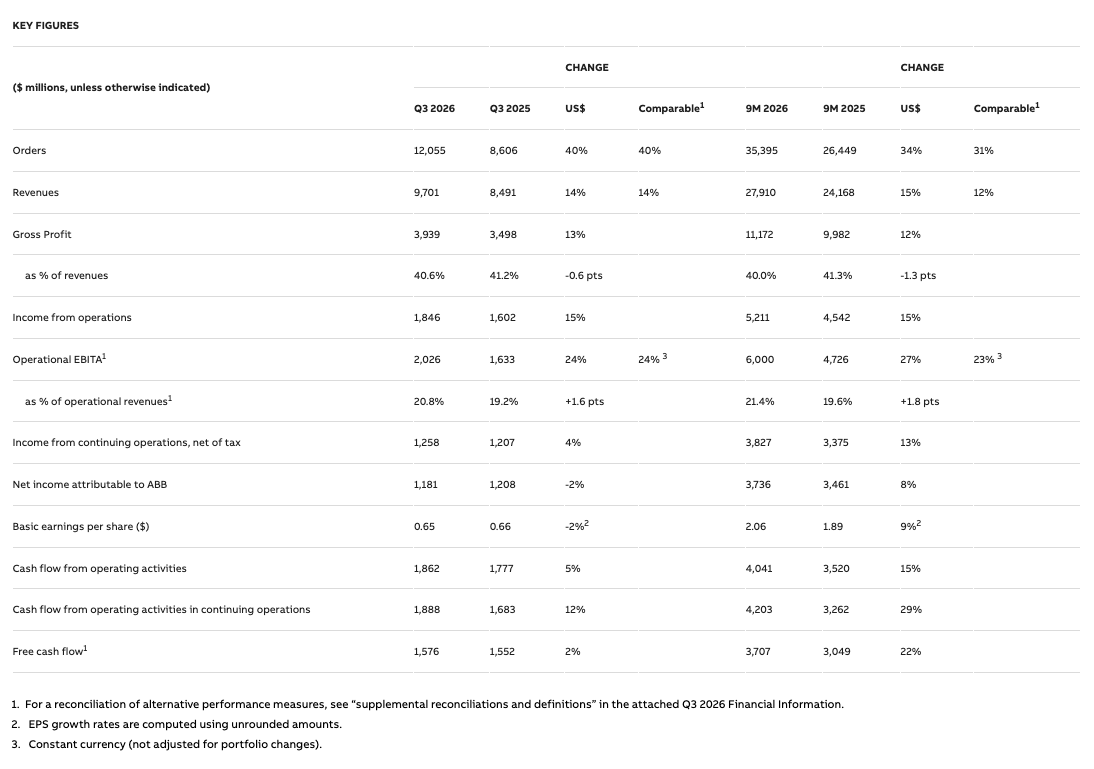
Our third quarter order intake reached a record $12 billion, nudging up sequentially; a stronger outcome than the historical pattern of seasonal decline. Year-on-year, orders grew 40% (40% comparable), driven by strong growth in two of our three business areas with a positive development across the majority of customer segments. Most notably so in the data center segment where we saw a triple-digit increase. Revenues were strong, yet order intake was even stronger, yielding a book-to-bill of 1.24.
Overall, we progressed according to plan. We converted strong revenue growth of 14% (14% comparable) into a 24% increase in Operational EBITA which reached $2 billion with margin expanding 160 basis points to 20.8%. We also materially improved Income from operations by 15% with a margin of 19.0%. Earnings per share remained virtually stable, reflecting increased Net finance expenses mainly due to the non-cash revaluation of the deal contingent FX hedge linked to the announced Rotork acquisition. We continue to deliver strong Return on capital employed which improved to 29.9%.
This was yet another solid cash flow quarter. Free cash flow of $1.6 billion was supported by robust earnings combined with disciplined management of Trade net working capital, which more than compensated for higher capex spend. This supported a sustained solid Free cash flow margin of around 14%, on a 12-month rolling basis. At $3.7 billion year-to-date, we are well positioned to surpass last year’s annual level of $4.6 billion.
In the current strong market environment it is essential to maintain focus and discipline, and we incrementally scale capacity to support our strong delivery track record. We already trend at a higher capex level of around $1 billion and do not expect it to rise further in the mid-term. Our investment approach is deliberate: incremental capacity expansion, productivity through automation, and selectively leveraging third-party assembly; balancing capturing of near-term demand with long-term resilience.
A significant milestone was the launch of the Infinitus Direct Current (DC) portfolio, enabling AI data center customers to achieve higher power density and improved energy efficiency. Our portfolio comprises five building blocks that can be combined into complete systems tailored to specific architectures. This includes a Solid State Transformer commercially available in the second half of 2027. We are able to partner with our customers from source to rack across the full spectrum of DC architectures. The portfolio enables acceleration of adoption of DC architectures in data centers and other energy-intensive industries.
Our partnership with Ferrari Hypersail demonstrates our commitment to advancing DC technologies and promoting their broader adoption across industries. The project – a 100-foot, renewable-powered full-foiling monohull yacht – is conceived as an operational proving ground for next-generation microgrid architecture. Its focus on energy management, marine electrical systems, and energy storage closely aligns with our expertise in these areas. The vessel is designed to operate as a fully self-sufficient system, integrating 800 VDC architectures. The engineering challenge central to this partnership – real-time orchestration of renewable generation, storage, and power distribution – mirrors the critical dynamics of emerging industrial microgrids.
It is also good to see our M&A activities bearing fruit. Following the Rotork announcement in July, we today announced that we will acquire a controlling 51 percent stake in a joint venture (JV) to be formed with Mitsubishi Electric’s low voltage power distribution business, with an option for full ABB ownership in the mid-term. This deal will make us the low voltage market leader in Japan, one of the world’s largest electrification markets, allowing us to benefit from the broad electric power trends including any local data center build-out. It also opens doors to the Asia-Pacific region. The Mitsubishi Electric business to be contributed to the JV generated around JPY 102 billion (~$640 million) in revenues in its fiscal year 2025, with a low double-digit EBITDA margin. We expect the joint venture to improve to at least a 20 percent Operational EBITA margin within 5 years. Similar to our successful GEIS acquisition, the profitability improvement will be driven by expanding sales through combined channels, introducing ABB products and technology to Mitsubishi Electric’s customer base and optimizing manufacturing. We acquire a controlling 51% stake in the newly carved out company as well as full ownership of Mitsubishi Electric’s JV-related sales operations outside of Japan for a total consideration of around JPY 79 billion (∼$495 million). These sales operations outside of Japan represent approximately 15% of revenues. The transaction values the combined businesses at a total enterprise value (EV) of about $890 million. Combined, this translates to valuation multiples of EV/Sales ∼1.4 and EV/EBITDA of ∼11.1 based on reported fiscal year 2025. The latter reduces into the mid- to high single-digit range when assuming realization of expected synergies. We see long-term returns well above cost of capital.
Outlook
In the fourth quarter of 2026, we expect comparable revenue growth to be broadly similar to the third quarter and Operational EBITA margin to sequentially soften although less than historical pattern. This excludes the positive impact of ∼CHF240 million related to the sale of properties already completed in Q4.
In full-year 2026, we expect a positive book-to-bill, and comparable revenue growth in the ”low teens” range, year-on-year. The reported Operational EBITA margin should improve by at least 270 basis points year-on-year.
Tagged with ABB, Biggest News, financial results