






FARGO, N.D., October 19, 2026 — Border States has published the following supply chain update.
Lead Time Trends

Canadian import ban takes effect as U.S.-China tariff reductions are announced
Several U.S. tariff-related developments occurred since September.
- Canada: The United States’ import ban on certain Canadian goods took effect in late September, while broader U.S. and Canada’s tariffs remain in place. Customers purchasing Canadian-origin products or products that rely on Canadian inputs should verify whether specific items are affected rather than assuming an entire product category is included.
- China: Following the U.S.-China summit, the two countries agreed to reciprocal tariff reductions covering approximately $30 billion in non-sensitive goods each. The reductions will take effect after both countries complete their required domestic procedures. The countries also extended their trade truce until Sunday, January 10.
- Section 232 metals: No material change to the current steel, aluminum and copper tariff structure. The Department of Commerce proposal to add 14-metal containing product categories, including certain electric conductor cables, remains under review.
- Section 301: The 10% and 12.5% tariffs implemented in July on 60 trading partners covering 99.4% of U.S. imports, remain in effect. In late September, the U.S. Court of International Trade heard arguments challenging the legal basis for these tariffs; it has not yet issued a ruling.
The bottom line: Product origin, classification, material content, quote validity and supplier documentation remain the main factors affecting total delivered cost. We continue to work with suppliers to understand potential cost and availability impacts.

Labor conditions remain stable but uneven as the Federal Reserve raises rates
Payroll growth slowed considerably from August, with 29,000 jobs added, down from a revised 133,000 jobs in August and, below expectations.
By the numbers: Unemployment edged up to 4.2%, from 4.1% in August. Wage growth softened further at 0.1% month over month. At the same time, labor force participation rose to 61.8%, from 61.6%, suggesting more workers are entering or re-entering the workforce.
Why it matters: Employment across most major industries changed little during September. While hiring momentum has slowed, labor demand remains relatively stable in many infrastructure- and project-related industries.
The Federal Reserve raised rates for the first time in three years, increasing the federal funds target range by 25 basis points to 3.75%–4% in September. Another rate hike is anticipated by year-end. Borrowing, project financing and inventory-carrying costs may remain elevated.
The bottom line: Expect labor conditions to remain stable but uneven through year-end. Labor challenges are likely to remain concentrated among electricians, utility crews, field service technicians, transportation-related positions and other skilled project-specific roles.

Transpacific rates climbed as capacity reduced
Transpacific rates hit new highs in mid-September as carriers kept capacity tight.
By the numbers:
- Drewry’s World Container Index ended September at $4,434/FEU (40-foot equivalent units), down 9% from August but still approximately 166% higher year over year.
- On the U.S. East Coast (USEC) trade lane, Shanghai-to-New York rates climbed 11.4% to $10,394/FEU by mid-September.
- On the U.S. West Coast trade lane, Shanghai-to-Los Angeles rates rose 13.1% to $7,712/FEU by mid-September.
- Carriers planned 47 blank sailings across major east-west trade routes from late August through early October, approximately 6% of scheduled capacity.
Why it matters: The transpacific has become a carrier-managed market rather than a demand-driven one. Importers did not stage a conventional peak, yet carriers held USEC rates above $10,000/FEU by reducing capacity ahead of China’s Golden Week national holiday and layering Panama Canal surcharges onto already elevated base rates.
Key takeaway: With Golden Week pausing Chinese factory output in early October and vessel delays clustering arrivals into November, U.S. imports will likely see firm pricing and schedule variability through the end of the year.

Surface market pricing pressure returns as diesel reaches record highs
September brought the brief August cooldown to an end, as surface rates turned back up and diesel prices reached record highs. The International Energy Agency expects diesel supply to remain tight into 2027 as falling inventories and supply disruptions continue to strain the market.
By the numbers:
- Spot rates: Dry van climbed 4.2% month over month to $3.01 per mile and flatbed rose 2.3% month over month to $3.62 per mile.
- Contract rates: Van rose 4.2% month over month to $3.24 per mile, flatbed rose 3.6% month over month to $4.07 per mile.
- Load-to-truck ratios tightened with van ratio rising 9.3% to 11.3 and flatbed ratio rising 8.4% to 39.0, while total for-hire tractors continued to decline.
- Intermodal: Cumulative volume remained strong, reaching 48 million units, through the first 37 weeks of 2026, up 4.1% year over year.
What this means: The surface market’s brief summer exhale is over, and the structural squeeze is back in force. Spot and contract rates rose altogether, load-to-truck ratios tightened, and diesel prices set new records, all while new capacity failed to materialize despite a year of elevated rejections.

Elevated commodity prices continue to shape material costs
Through October, copper, aluminum and steel remain the key commodities to watch, while resin and PVC markets continue to reflect strong infrastructure and data center demand.
Across the categories:
- Copper remains 31% above prior year levels despite declining 1% month over month.
- Aluminum is still 26% higher than last year after falling 3%.
- Hot-rolled steel increased another 1% and remains 57% above year-ago levels.
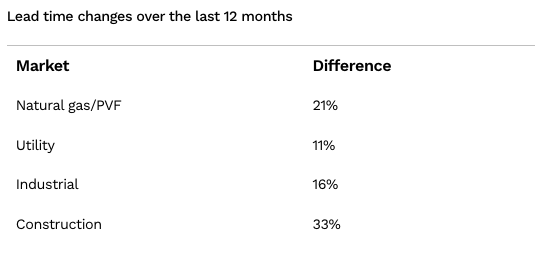
- PVC price increases have now held for two consecutive months, and larger-diameter conduit and pipe products continue to see extended lead times.
- Resins remain elevated, while demand from power infrastructure, electrification and data center projects continues to support overall commodity markets.
What we’re watching: Trade policy, geopolitical risks, new production capacity and supplier activity could continue to influence costs in the near term. Potential changes to Section 232 tariffs and proposed copper derivative tariffs also remain longer-term watch items.
Looking ahead: Expect continued volatility across metal-intensive and project-driven categories over the next 60–90 days. Focus on early planning, quote validity, alternative supply options and project visibility.
Bonus: Read our 2026 State of Commodities report for a high level overview of the top factors impacting commodities and what to watch for in 2027.

Tagged with Border States, supply chain