




tED magazine talks with NAED’s Director of Government Relations, Bud DeFlaviis, about why distributors usually do not have a direct claim to IEEPA tariff refunds, why unwinding tariff-driven price increases is so difficult, and how distributors can explain that reality to customers.
Editor’s note: This interview is for general informational purposes only and is not legal advice. It has been edited for length and clarity.
 tED magazine: Bud, what is the biggest misunderstanding in the market right now about tariff refunds?
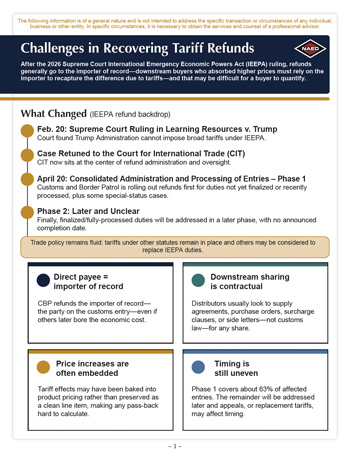
Bud DeFlaviis: We hear a lot that since the IEEPA tariffs were struck down, everyone who absorbed higher prices will easily get money back. That’s not how this works. The Supreme Court’s February 20, 2026 ruling held that IEEPA did not authorize the broad reciprocal and drug-trafficking tariffs, and CBP (Customs and Border Protection) has launched its refund process using a tool called CAPE (Consolidated Administration and Processing of Entries). But that government refund process is built around the importer of record — the party that paid Customs — not every company farther down the supply chain that later paid higher prices. (Supreme Court)
tED magazine: So who actually has the legal claim to a refund?
Bud: In most cases, the importer of record does. CBP’s guidance says CAPE submissions are made by the importer of record or its authorized customs broker through a portal, with refunds issued electronically. Phase 1 is live now, but it doesn’t cover around 40% of duties that were paid. Later phases for more complicated claims are still being developed, and CBP has not given a public deadline for finishing those later phases. (GovDelivery)
tED magazine: What does that mean for a distributor that paid a manufacturer’s tariff-related price increase?
Bud: It means the distributor usually does not have a direct CBP claim just because you paid a higher price. If the distributor was not the importer of record, customs law generally does not turn that economic burden into a government refund right. Any recovery path is usually commercial and contractual. In other words, the answer is more likely to be found in supply agreements, surcharge language, purchase orders, side letters, or negotiated refund-sharing arrangements than in customs law itself. (Arnall Golden Gregory LLP)
tED magazine: Why is it so hard to unwind those price increases after the fact?
Bud: Because in many channel transactions the tariff cost was not passed through as a clean, separately identifiable customs line. It may have been embedded in the price you paid. Once that happens, it becomes very difficult to separate how much of a price increase came from tariffs versus freight, inflation, sourcing shifts, or general margin pressure. And before a distributor can even argue over pass-through, the manufacturer or importer still has to receive its own refund first. (Foley & Lardner LLP)
tED magazine: So when customers ask distributors, “Are you going to refund the tariff increases we paid?” what is the honest answer?
Bud: The honest answer is that a distributor generally does not have a direct customs refund claim unless it was the importer of record, and the customer usually has even less of a direct path because it is another step removed from the customs entry. In practical terms, any recovery would depend on the terms and conditions channel partners operate under – it’s essentially a business discussion at that point. (Arnall Golden Gregory LLP)
tED magazine: What is the clearest way for a distributor to explain that to a customer?
Bud: You know your customers. Far be it from me, a lobbyist, to tell you how to manage your customer relationships! But the bottom line is that any government refund goes first to the importer of record, not automatically to everyone in the supply chain. If you did not pay Customs directly, any recovery would depend on whether the importer receives a refund and whether contracts or the nature of your relationship indicates that refund to be passed through.
tED magazine: Are the tariffs gone? Are they coming back?
Bud: The IEEPA tariffs are gone. However, other tariffs imposed under the Trump administration remain in effect and the President has signaled that he wants to continue to find mechanisms to impose additional tariffs. Stay tuned to our Washington Wire updates to keep current. If you want to talk about tariffs or any other policy questions, email me at bud@naed.org and I can give you a call.
Tagged with Biggest News, NAED, tariffs